
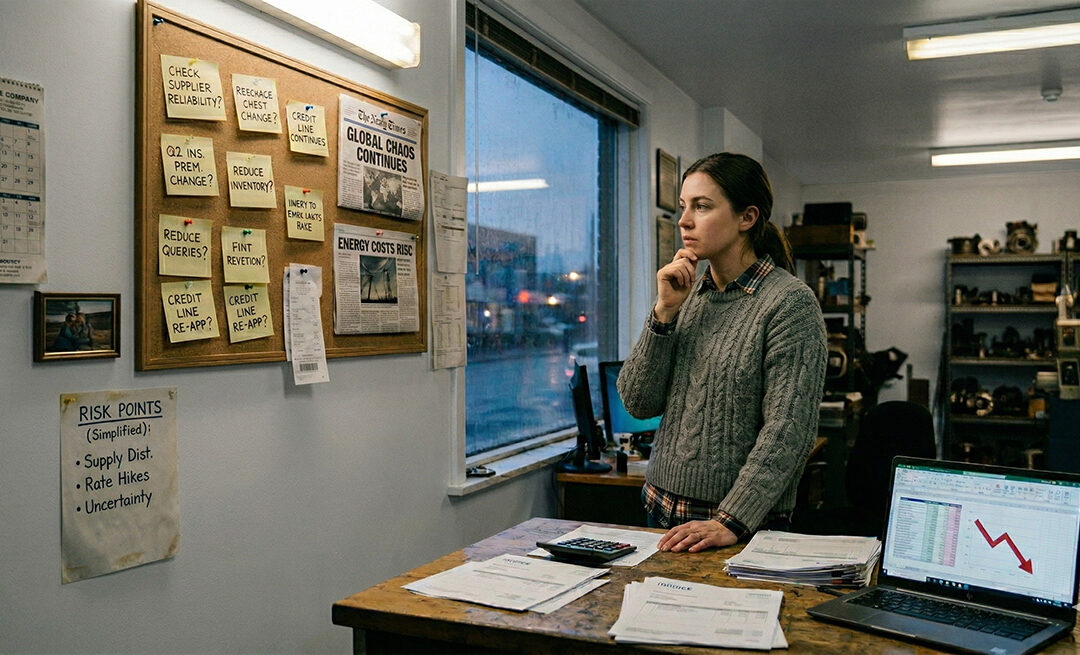
Trouble Ahead
Unfortunately, the world is becoming increasingly risky and unstable, and small businesses are often the most exposed to economic downturns, geopolitical risk, inflation and rising interest rates.
The post-1945 global economic system based on free trade, globalisation and relatively stable geopolitics is changing. Political tensions between major powers (a new “Cold War” between the USA and China), supply chain disruption, energy price volatility, stubborn inflation, climate change and other factors are creating a much more uncertain economic environment for businesses.
And of course, as well as the “Cold War”, there are real wars raging in Ukraine and now, sadly, in Iran, dragging in the rest of the Middle East and everyone else.
Economically, the Iranian conflict is shaping up to be much more serious than the Russia-Ukraine war. Higher energy prices, inflation and interest rates are already impacting consumer demand, borrowing costs and business investment. Even if the military conflict ends soon, the economic impact may last for years through higher inflation and tighter financial conditions as central banks inevitably use their traditional counter-inflationary weapon, the “double-edged sword” of higher interest rates.
In short: the risk of recession, slow growth, and rising interest rates has increased. Governments are also less able to support businesses financially than they were during COVID because of high public debt levels.
What can Small Businesses Do?
For small and medium-sized enterprises (SMEs), survival will increasingly depend on strategy, cashflow management, risk management and business resilience.
Small businesses, often family-owned, are usually more vulnerable than large companies because they have less financial resilience, fewer staff, etc.
However, the situation is “serious but not hopeless”. There are six key areas where every small business owner should proactively focus to survive economic and political uncertainty:
- Strategy
- Cashflow
- Stress-Testing Your Business
- Risk Management
- Building Resilience, Not Just Growth
- Planning For the End of the Era of “Easy Money”
We will consider each of these in greater detail in separate articles over the next few weeks. What follows is a brief summary.
1. Strategy Matters Even More When the World is Unstable
As noted in our previous article (6 Common Mistakes Small Business Owners Should Avoid), many business owners confuse goals with strategy. Goals are what success looks like (e.g. sales growth) whereas strategy is a plan for achieving those goals.
In turbulent times, small businesses should regular review their strategy and adapt quickly.
2. Cashflow is Now Even More Important Than Profit
There is a well-known saying in business: “Profit is opinion, cash is reality.”
Economic stress can be seen in small businesses through:
- Falling sales
- Customers paying late or going bankrupt
- Higher energy costs
- Higher interest rates (or higher-for-longer)
- Banks becoming more cautious about lending
- Businesses failing not because they are unprofitable or their product ideas are bad but because they simply ran out of cash.
Practical cashflow management solutions include:
- Faster invoicing
- Chase late payments
- Reduce excess stock
- Renegotiate supplier payment terms
- Control costs
- Maintain a cash buffer
- Arrange credit facilities before they are needed
- Prepare cashflow forecasts
3. Stress Testing Your Business
Stress testing and scenario planning are no longer just for large corporates: every small business should regularly ask “What if?”
For example:
- What happens if sales fall 20%?
- What happens if costs rise by 20%?
- What happens if a major customer is lost?
- What happens if interest rates double?
- What happens if several of these occur simultaneously?
Stress testing helps business owners prepare contingency plans and avoid being surprised by external shocks. All downside scenarios should be on the table for consideration, assumptions should be challenging but plausible, and the whole process should be regularly repeated as circumstances change.
4. Risk Management
Some people think that grand concepts such as “enterprise-wide risk management” are only for big companies such as banks.
Actually, the universe of risks is expanding fast for all businesses, regardless of size, and the endless iterative process of risk management: from comprehensive risk identification, assessment and control to mitigation / avoidance is one that every enterprise should take seriously, particularly in a tough economic environment.
Key risks that small businesses should consider:
- Supplier concentration risk and supply chain disruption
- Customer concentration risk
- Interest rate risk
- Energy cost risk
- Cyber risk and fraud
- Operational risk, e.g. power outages
- Liquidity risk
- Key person risk
- Regulatory risk, e.g. international trade sanctions
- Geopolitical and economic risk
Some simple risk management actions:
- Diversify suppliers
- Closely monitor key customers
- Review borrowing and interest rates
- Arrange contingency funding
- Review insurance coverage
- Create a “Business Risk Register” showing all the categories of risk, how they are to be managed, and by whom, then regularly update it
- Develop contingency and business continuity plans, then regularly test them
5. Building Resilience, Not Just Growth
During periods of economic stability, businesses often focus on growth. During uncertain periods, the priority should be resilience and survival.
A resilient small business typically displays the following characteristics:
- Clear strategy
- Strong cashflow, tightly managed
- Low or manageable debt
- Multiple customers
- Multiple suppliers
- Reliable staff
- Sensible, pragmatic leadership
- Good financial controls
- Contingency and business continuity plans
The next decade may be even more volatile than the last, so resilience should be a key business goal.
6. Plan For the End of the Era of “Easy Money”
For many years after the Global Financial Crisis of 2007-2008 and during COVID, interest rates were extremely low, and many businesses became used to very cheap borrowing.
That era was over even before the current US-Iran conflict escalated in March 2026, as a result of which interest rates will probably remain higher-for-longer due to inflation, energy prices, and global economic volatility.
Small businesses should therefore:
- Reduce unnecessary debt
- Avoid over-reliance on external borrowing
- Fix interest rates where possible
- Prepare realistic budgets
- Improve financial forecasting
- Build cash reserves
- Work closely with a good accountant also capable of providing valuable insights about your business
Final Thoughts
The global economy is becoming increasingly uncertain, with higher inflation, higher interest rates, slower (maybe even negative) growth, fragmented supply chains, and the escalation of existing risks as well as the emergence of new ones. Small businesses cannot control global events, but they can control strategy, cashflow, resilience, risk management and financial planning. Businesses that focus on these areas are far more likely to survive and prosper during economic turmoil.
Let Us Help You
If you want friendly, impartial advice on small business strategy, risk management, cashflow planning, business resilience or preparation for recession, we specialise in helping SMEs navigate difficult economic conditions. Please get in touch for an initial discussion.
Ready to Find Out How Financially Healthy Your Business Really Is?
Take our Business Health Check and discover the opportunities, risks and next steps that could help you build a stronger, more profitable and sustainable business.